|
|
It is believed that Lithuania got its name from the River Lietava (Lietauka), a tributary of the Neris. It flows about 25km from the little town of Kernave, an important political centre in ancient Lithuania in the eastern part of country. Lithuania was first mentioned in the Annales Quedlinburgenes, a Latin chronicle, in 1009.
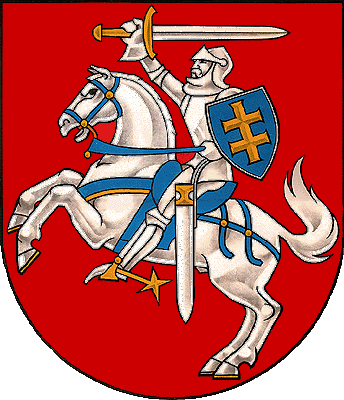
The Lithuanian mounted knight, called Vytis, is one of the oldest state emblems in Europe. It dates back to 1366, the time of Grand Duke Algirdas, and became an emblem of the Grand Duchy of Lithuania at the beginning of the 15th century. In 1819, Vytis became the foremost symbol of statehood of Lithuania.
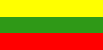
The state flag was created in 1918. The colours of the flag symbolise: yellow - the sun, light and prosperity; green - the Lithuanian landscape, hope and joy; red - the colour of the earth, life and blood. It symbolises the nation's courage and tenacity in the struggle for freedom.
The words and music of the Lithuanian national anthem, also known as Tautine giesme, were written by Vincas Kudirka. It was published for the first time in 1898, and first publicly performed in Vilnius in 1905. 1918 Tautiné giesmé officially became the national anthem of the Republic of Lithuania. During the years of Soviet occupation, it was forbidden to play it.
The Seimas (Parliament) is the highest body of state power. It consists of 141 MPs selected for four-year terms. The President of the Republic is elected by direct suffrage for a term of five years. President Valdas Adamkus took oath on 26 February 1998. The Government is composed of the Prime Minister and 14 ministers. The Prime Minister is appointed or dismissed by the President with the approval of the Seimas.
The total length of the inland borders is 1,609 km, with the coastline adding another 99 km. There are no islands
in the Baltic Sea belonging to Lithuania.
In the north, it borders Latvia (546 km border), in the east and south Belarus (650 km), in the south-west Poland
(110 km) and Kaliningrad region of the Russian Federation (303 km). From east to west the country is 373 km, and
from south to north 276 km.
The country has a diverse landscape - three hilly uplands, and three lowland plains. The highest point is Juozapine Hill, not far from Vilnius, it is 293.6 m above sea level. There are over 4,000 lakes and 722 rivers. The longest river is the Nemunas, which is 937 km long. Its length through Lithuania is 475 km.
Transitional, between maritime and continental. Average temperatures: yearly 6.7°C; January -4.9°C; July 17°C; but it can be as high as 30°C in summer and as low as -32°C in winter. Annual precipitation level: 744.6 mm. Humidity: 78%. Any season, don't forget your umbrella.
Cultural and language differences distinguish the regions of Zemaitija (western Lithuania), Aukstaitija (mid and eastern Lithuania), Suvalkija (below the Nemunas) and Dzukija (southern Lithuania).
Mostly Roman Catholic. Others - Russian Orthodox, Evangelical Lutheran, Judaic, etc.
Lithuanian is an archaic language. It has retained its ancient sound system and morphological characteristics. Of all the living Indo-European languages, Lithuanian is the most similar to Sanskrit. The 32-letter Lithuanian alphabet is Latin based.
| January 1 | New Year's Day |
| January 13 | The Day of the Defenders of Lithuania's Freedom, to commemorate the peaceful protesters who were killed in 1991, by Soviet troops. |
| February 16 | Independence Day. Lithuania declared its independence in 1918. |
| March 11 | Day of the Restoration of Lithuania's Independence. The act was signed in 1990. |
| April 23 | Easter Sunday |
| May 7 | Mother's Day |
| June 1 | International Children's Day |
| June 14 | Day of Mourning and Hope. In 1941, the Soviets began mass deportations to Siberia. |
| June 23 | Insurrection Day. An armed uprising against the Soviet occupation occurred in Vilnius and Kaunas in 1941. |
| July 6 | Statehood Day commemorates the coronation of Lithuania's first and only king, Mindaugas, in 1253. |
| August 23 | Black Ribbon Day. In 1939 the Molotov-Ribbentrop pact was signed which handed the Baltic republics over to the Soviet sphere of interest. |
| September 8 | Day of the Nation. The coronation of Grand Duke Vytautas was originally planned for this day in 1430; he died before it took place. |
| September 23 | Commemoration Day of the Victims of the Holocaust. |
| November 1 | All Saint's Day. |
| December 25 | Christmas Day. |
The litas is the only legal tender in Lithuania. 100 cents = 1 litas (LTL or Lt). At present, banknotes come in 1, 2, 5, 10, 20, 50, 100 and 200 denominations. Coins are minted in values of 1, 2, 5, 10, 20, 50 cents and 1, 2, 5, 10 and 50 litas. The current exchange rate is LTL 4 = USD 1. Most hotels, restaurants, shops and petrol stations accept major credit cards such as Visa, Eurocard, American Express and others.
Lithuania is in the Central European Time Zone, GMT+2 hours.
Visas are issued by the diplomatic missions and consular offices, the Consular Department of Foreign Affairs, as well as the Migration Department under the Ministry of Internal Affairs.
Nationals of these states may enter Lithuania without visas: Andorra, Australia, Austria, Belgium, Bulgaria, Canada, Chile, Croatia, Cyprus, The Czech Republic, Denmark, Estonia, Finland, France, Germany, Greece, Hungary, Iceland, Ireland, Italy, Japan, Latvia, Liechtenstein, Luxembourg, Malta, Monaco, The Netherlands, New Zealand, Norway, Poland, Portugal, San Marino, Slovak Republic, Slovenia, Spain, Sweden, Switzerland, United Kingdom, United States of America, Vatican and Venezuela.
Nationals of these countries in possession of a visa from one of the three Baltic states can enter the other two states: Israel and South Africa.
The Ministry of Foreign Affairs tel. +370 2 620 147.
|
|
||||||
| By Rail: From Western Europe via Warsaw. | By Car: From Western Europe via Lithuanian-Polish border checkpoints at Lazdijai and Kalvarija. |
Sixty km/h in built up areas, 90 km/h on country roads and 110 km/h on motorways. Seat belts for drivers and front-seat passengers are compulsory.
|
|
The voltage in lithuania is 200 VAC 50 Hertz. European plugs are required.
Almost all public phone booths are now card phones. You can buy cards at any post office or newspaper kiosk.
International calls can be made directly from virtually all telephones. Dial 8, wait for the dial tone, followed by 10, dial the country or area code, the city code and the number you are calling. To make a long-distance call, dial 8, wait for the dial tone, dial the city or area code (Vilnius 8-22, Kaunas 8-27, Klaipeda 8-26) and the number you wish to reach. For further listings of city codes, call 654 611 in Vilnius.
It may be called Baltic gold, but it isn't always yellow. It can also be brown, white, blue or black. Sometimes it has dead insects preserved inside. Formed from the resin of coniferous trees, it may be up to 50 million years old. It is mined on the Baltic coast and can also be washed up on the beach after a storm.
From towel racks and distaffs, to masks and statues of the Pensive Christ, carvings represent aspects of rural culture; as do the trays, baskets, cradles, lampshades, stools, tables and chairs available in wicker.
Bedspreads, tablecloths and tablemats usually come in two colours, which are their natural colours, and in simple geometric patterns. Sashes are made for ceremonial occasions and worn as part of the national costume.
Other souvenirs include painted eggs, leather objects, ceramics, wooden toys, stained glass and handmade notebooks.
| Some vital items of vocabulary: thank you = aciu; please = prasom; yes = taip; no = ne, excuse me = atsiprasau; hello = laba diena; goodbye = sudie. |
Useful Telephone Numbers: Fire Brigade: 01 Police: 02 Ambulance: 03 |
Dial 231 414 for The Magic Phone (In Vilnius, 24 hrs). They guarantee to answer any question on any subject. If you want to know where to get a suit cleaned, or you just want the recipe for pancakes, try them. |